Many do not believe there is global warming. Ok, the research may still out on that, personally I believe it is a combination of events both man-made and natural but you can not dismiss the fact that the world is suffering from the lack of clean fresh water. I suggest you take some time to read the April issue of National Geographic (click on the title above) to expand you knowledge of what is happening. It will affect you no matter where you live. Example, one major earthquake could destroy California's water supply. California grows over half of this countries vegetables, fruits and nuts. Can you imagine the effects? The Middle East is at constant war over the rights to the Jordan River. Poor decisions around the world affect you more than you will know.
We are spoiled, it magically comes from our taps, but when you look at the whole process you will find that we are just one step from disaster.
Farming utilizes 70% of our water. Recently many farmers have modified their systems and reduced their consumptions by over a third. And they continue to come up with ingenious ways of doing so. Help them out. I urge you to support the local farmers in your area, they will need to support you in the very near future; ration your use of water voluntarily, reuse and recycle water. Collect rain water, it can be filtered and will be safer than what you are currently getting from your tap and in your bottles. Change local laws and codes to allow the use of recycled water systems.
As I continue to research sustainable systems, I will, for those who are interested, post them so that you can make simple modifications to your own home. You will help the world and save money at the same time. This isn’t political or anything else. I am only becoming a realist; I have to change as well.
Showing posts with label free. Show all posts
Showing posts with label free. Show all posts
Tuesday, March 30, 2010


Monday, March 15, 2010
Free Energy Is Here as it always has been.
What would you do if you had found the answer to all our energy needs? Would take the money they offer to keep it quiet or be stoned to death by the academics’ and corporations of the world for heresy against our energy dogma.
In my search for sustainable systems I have come across the principals of free energy many times. It is out there, though many will deny it, defending their PhD’s because they can’t bear to have been wrong all these years. I have enclosed links below because seeing is believing. Look these inventors up on you tube and you will be surprised at how many people have built these motors at home from junk based on the knowledge the men below have offered up for free. The principal is simple so don’t get lost in the technical details and circuitry or the arguments for and against. Just be aware that it is available to everyone. Several of the inventors have been told to keep quiet and refused, so they were debunked at every opportunity (Google; John Bedini or Tom Bearden). But magnetic motors have been around since 1269 AD.
Now, Steorn Orbo Technology (see; http://www.healthsalon.org/482/orbo-steorn-free-energy-electromagnetic-energy-is-here/ ) has put their own version out there for anyone to test and prove them wrong. If they can not find fault, and I don’t believe they can, everything we have known before will change. Imagine, cars, electricity for home and office, motors of all shapes and sizes that require no fuel. This is where we should be investing our money. And this is where we should have been years ago.
Remember the names Peter Peregrius (1269AD), Lee Bowmen (1954), John Bedini, Tom Bearden, David Hamel and now Steorn Orbo Technology. They have all built knowledge off of their predecessors and each other, they have stood in the forefront, taking their shots to the point of being called frauds but they will survive and you will benefit from their stubbornness.
To see for yourself visit the links below and the many others that will pop up.
http://www.healthsalon.org/482/orbo-steorn-free-energy-electromagnetic-energy-is-here/
http://www.icehouse.net/john1/bearden.html
http://www.youtube.com/watch?v=9JikYfmEdF8&feature=related
In my search for sustainable systems I have come across the principals of free energy many times. It is out there, though many will deny it, defending their PhD’s because they can’t bear to have been wrong all these years. I have enclosed links below because seeing is believing. Look these inventors up on you tube and you will be surprised at how many people have built these motors at home from junk based on the knowledge the men below have offered up for free. The principal is simple so don’t get lost in the technical details and circuitry or the arguments for and against. Just be aware that it is available to everyone. Several of the inventors have been told to keep quiet and refused, so they were debunked at every opportunity (Google; John Bedini or Tom Bearden). But magnetic motors have been around since 1269 AD.
Now, Steorn Orbo Technology (see; http://www.healthsalon.org/482/orbo-steorn-free-energy-electromagnetic-energy-is-here/ ) has put their own version out there for anyone to test and prove them wrong. If they can not find fault, and I don’t believe they can, everything we have known before will change. Imagine, cars, electricity for home and office, motors of all shapes and sizes that require no fuel. This is where we should be investing our money. And this is where we should have been years ago.
Remember the names Peter Peregrius (1269AD), Lee Bowmen (1954), John Bedini, Tom Bearden, David Hamel and now Steorn Orbo Technology. They have all built knowledge off of their predecessors and each other, they have stood in the forefront, taking their shots to the point of being called frauds but they will survive and you will benefit from their stubbornness.
To see for yourself visit the links below and the many others that will pop up.
http://www.healthsalon.org/482/orbo-steorn-free-energy-electromagnetic-energy-is-here/
http://www.icehouse.net/john1/bearden.html
http://www.youtube.com/watch?v=9JikYfmEdF8&feature=related
Thursday, March 11, 2010
Baby steps & a lot of but...A conservative look into sustainable housing
click the title to see
The Oscar the Grouch of architecture - earthship.com
earthship.com
Stephen Colbert sits down to talk trash with "Garbage Warrior" Michael Reynolds. Fri, Mar 27 2009 at 9:19 AM EST
Michael Reynolds aka ‘The Garbage Warrior’ is a person with great conviction. He has led the way for many of us to get what would be known as ‘non standard’ or ‘those crazy self sustaining designs’ through our local building departments. Many of who don’t want to make their job more difficult by dealing with the unknown and some, in my experience, even make codes up on the fly due to their personal opinion or lack of understanding. For the most part local governments are made up of very conservative people. Mr. Reynolds has broken through a number of these barriers and he has some great ideas. His homes are built with rammed earth in tires, old bottles and cans as bricks; sewage recycled and rain collection systems which are all excellent. However, there is always a however or a but, even with all of this, most of his designs are more related to an artist rather than a conventional family. Only the bravest want to brag or even admit their home is built from junk, it is a new way of thinking and a smart one I have to say. So for anyone who is willing, as I am, I appalled you.
Here comes the but again,
To get the average person to change their way of thinking, we must take baby steps. Most environmentalist believe there is no time for that but when you consider that many people still believe that there is no global warming at all, that it is just a hoax, then saving the environment as an argument is out of the question. They want their old economy back where convenience is everything. Even so, they can not argue with saving money. Even if they were right, there is still something in it for them, that’s $$$ and money talks. Now the ones who have been hit hard by that very same economy, have learned they want nothing more than to be able to live comfortably without the fear of losing their heat, electric or their homes entirely due to natural disasters or lose of income. They will easily change their way of thinking if we make it a little more, let’s say acceptable in design.
I differ from Mr. Reynolds’ ideas in several areas. The first is design; if we make it more conventional, a standard floor plan is easily accomplished with the use of concrete or block or any material that can be formed in straight or curved lines and carries a good thermal mass. You can argue that the energy involved in creating and transporting these materials is high, but, there it is again, if you consider that by using them in the short run you are eliminating the energy the home owner would have used over the lifetime of the home and that lifetime could be thousands of years. Remember we are looking at thermal mass and I am not recommending we cut down trees, if we do for design or necessity we need to replace them three fold. What I am saying is we are not going to get the majority of this country to change their vision of what a home can be, to utilize waste or even consider these ideas unless we take baby steps. Energy efficient housing is acceptable now, but there is little acceptance of underground or berm type housing. Caves, darkness and fear of collapse are the first thought that comes to the average persons mind when in reality these are the safest and can have more natural lighting than what is now standard in other dwellings. Not to mention they will save huge amounts of money on their utilities if you do nothing more than the simplest earth tubes and natural ventilation.
Second, as a nation we have become germiphobes. Although I am all for it, many people, especially those who want their economy back, as a general rule are not willing to have their waste systems or greywater running through their homes and growing their food in those systems. Remember, baby steps are the key. Maybe we take the waste outside first, process it and then bring it back through the system, or process it more efficiently so that is does not infect our ground water. I can guarantee that the average people in this country is not going to have any desire to sit on a toilet flushed with greywater no matter how clean it is, it is the thought. The thing they don’t realize is what they are drinking from their current taps can be and is probably worst, it is just a matter of out of sight, out of mind. My own municipal water system has failed miserably for the last 5 years running. Cancer causing agents etc….but the cost keeps going up to pump this crap into our home.
Rain water collection is probably the most acceptable change we can make now. Many a gardener will brag about how big their system is. But to use it even filtered completely for drinking (potable) water will take time to it get into people and our local government heads as safe. These days many people on the outskirts of town will abandon their wells completely as soon as municipal water reaches them. The convenience of having water under a steady pressure even if cold when power is out is enough to convince many a family. It is also the thought what well water has in it and we have all heard stories of local governments coming through and condemning wells as a rule by telling people they don’t pass their health standards or have a higher then recommended nitrate levels which will damage a baby’s liver. We don’t want blue babies now do we, they say? All this just to get as many people hooked up as possible. Even if their tests are actuate, many times over the government will set the accepted levels much lower than recommended to save itself from lawsuit or just to guarantee the customer base it needs to provide the profitable service. How much pressure from the city and local jurisdiction are on these departments and inspectors? Does, what is good for all, outweigh the good of an individual. Sorry I drifted, back to it, in my case a properly filtered, gravity fed rainwater system plumbing throughout my home would have to be far superior to what I am getting now.
So how do we change the minds of our local and national government? We keep pushing, pushing for acceptance of new and ancient designs as a norm rather then the opinion ‘it is just some hippie’s hobbit home fantasy.’ And we have to make it cheaper in cost so that there is more attention brought to it. Currently it will cost you about $200 per sq ft. (unless you do most of the labor yourself) for a self sufficient underground or berm style home, which is far less costly than what you are paying now in a conventional home, when you consider the savings in utilities over the years. It also has to be sociably acceptable by today’s standards, which means a little more conservative. Everybody loves to say they know someone who lives in a unique home but few are willing to try it themselves. We need to make the systems (i.e. rainwater, solar, geothermal) cheaper, simpler & easier to retro fit older homes so that it become the norm rather than the exception. Baby steps, baby steps, baby steps….
By the way Earthship Biotecture (http://earthship.net/) is currently attempting this. But the systems need to be cheaper and you can build them yourself. Over the last winter here in the northeast, many people who had lost their income or retirement went without heat. I have studied simplifying systems for 3 years now and the simplicity of earth tubes and proper ventilation can prevent this. Even retro fitting to an older homes could be as cheap as a one day rental of a backhoe and 100’ of 6 “ PVC along with modifying ventilation at the top of the structure which can be as simple as an open window in some cases, you could have a self sustaining heating and cooling system that shy of the install would be free, forever.
So why aren’t we doing this? Because most people don’t know they can. So again, I thank Michael Reynolds for leading the way along with many other designers, architects and builders out there. I hope that you will consider this so called alternate way of life, because it really isn’t. It is just a common sense, simpler and less costly way of living.
The Oscar the Grouch of architecture - earthship.com
earthship.com
Stephen Colbert sits down to talk trash with "Garbage Warrior" Michael Reynolds. Fri, Mar 27 2009 at 9:19 AM EST
Michael Reynolds aka ‘The Garbage Warrior’ is a person with great conviction. He has led the way for many of us to get what would be known as ‘non standard’ or ‘those crazy self sustaining designs’ through our local building departments. Many of who don’t want to make their job more difficult by dealing with the unknown and some, in my experience, even make codes up on the fly due to their personal opinion or lack of understanding. For the most part local governments are made up of very conservative people. Mr. Reynolds has broken through a number of these barriers and he has some great ideas. His homes are built with rammed earth in tires, old bottles and cans as bricks; sewage recycled and rain collection systems which are all excellent. However, there is always a however or a but, even with all of this, most of his designs are more related to an artist rather than a conventional family. Only the bravest want to brag or even admit their home is built from junk, it is a new way of thinking and a smart one I have to say. So for anyone who is willing, as I am, I appalled you.
Here comes the but again,
To get the average person to change their way of thinking, we must take baby steps. Most environmentalist believe there is no time for that but when you consider that many people still believe that there is no global warming at all, that it is just a hoax, then saving the environment as an argument is out of the question. They want their old economy back where convenience is everything. Even so, they can not argue with saving money. Even if they were right, there is still something in it for them, that’s $$$ and money talks. Now the ones who have been hit hard by that very same economy, have learned they want nothing more than to be able to live comfortably without the fear of losing their heat, electric or their homes entirely due to natural disasters or lose of income. They will easily change their way of thinking if we make it a little more, let’s say acceptable in design.
I differ from Mr. Reynolds’ ideas in several areas. The first is design; if we make it more conventional, a standard floor plan is easily accomplished with the use of concrete or block or any material that can be formed in straight or curved lines and carries a good thermal mass. You can argue that the energy involved in creating and transporting these materials is high, but, there it is again, if you consider that by using them in the short run you are eliminating the energy the home owner would have used over the lifetime of the home and that lifetime could be thousands of years. Remember we are looking at thermal mass and I am not recommending we cut down trees, if we do for design or necessity we need to replace them three fold. What I am saying is we are not going to get the majority of this country to change their vision of what a home can be, to utilize waste or even consider these ideas unless we take baby steps. Energy efficient housing is acceptable now, but there is little acceptance of underground or berm type housing. Caves, darkness and fear of collapse are the first thought that comes to the average persons mind when in reality these are the safest and can have more natural lighting than what is now standard in other dwellings. Not to mention they will save huge amounts of money on their utilities if you do nothing more than the simplest earth tubes and natural ventilation.
Second, as a nation we have become germiphobes. Although I am all for it, many people, especially those who want their economy back, as a general rule are not willing to have their waste systems or greywater running through their homes and growing their food in those systems. Remember, baby steps are the key. Maybe we take the waste outside first, process it and then bring it back through the system, or process it more efficiently so that is does not infect our ground water. I can guarantee that the average people in this country is not going to have any desire to sit on a toilet flushed with greywater no matter how clean it is, it is the thought. The thing they don’t realize is what they are drinking from their current taps can be and is probably worst, it is just a matter of out of sight, out of mind. My own municipal water system has failed miserably for the last 5 years running. Cancer causing agents etc….but the cost keeps going up to pump this crap into our home.
Rain water collection is probably the most acceptable change we can make now. Many a gardener will brag about how big their system is. But to use it even filtered completely for drinking (potable) water will take time to it get into people and our local government heads as safe. These days many people on the outskirts of town will abandon their wells completely as soon as municipal water reaches them. The convenience of having water under a steady pressure even if cold when power is out is enough to convince many a family. It is also the thought what well water has in it and we have all heard stories of local governments coming through and condemning wells as a rule by telling people they don’t pass their health standards or have a higher then recommended nitrate levels which will damage a baby’s liver. We don’t want blue babies now do we, they say? All this just to get as many people hooked up as possible. Even if their tests are actuate, many times over the government will set the accepted levels much lower than recommended to save itself from lawsuit or just to guarantee the customer base it needs to provide the profitable service. How much pressure from the city and local jurisdiction are on these departments and inspectors? Does, what is good for all, outweigh the good of an individual. Sorry I drifted, back to it, in my case a properly filtered, gravity fed rainwater system plumbing throughout my home would have to be far superior to what I am getting now.
So how do we change the minds of our local and national government? We keep pushing, pushing for acceptance of new and ancient designs as a norm rather then the opinion ‘it is just some hippie’s hobbit home fantasy.’ And we have to make it cheaper in cost so that there is more attention brought to it. Currently it will cost you about $200 per sq ft. (unless you do most of the labor yourself) for a self sufficient underground or berm style home, which is far less costly than what you are paying now in a conventional home, when you consider the savings in utilities over the years. It also has to be sociably acceptable by today’s standards, which means a little more conservative. Everybody loves to say they know someone who lives in a unique home but few are willing to try it themselves. We need to make the systems (i.e. rainwater, solar, geothermal) cheaper, simpler & easier to retro fit older homes so that it become the norm rather than the exception. Baby steps, baby steps, baby steps….
By the way Earthship Biotecture (http://earthship.net/) is currently attempting this. But the systems need to be cheaper and you can build them yourself. Over the last winter here in the northeast, many people who had lost their income or retirement went without heat. I have studied simplifying systems for 3 years now and the simplicity of earth tubes and proper ventilation can prevent this. Even retro fitting to an older homes could be as cheap as a one day rental of a backhoe and 100’ of 6 “ PVC along with modifying ventilation at the top of the structure which can be as simple as an open window in some cases, you could have a self sustaining heating and cooling system that shy of the install would be free, forever.
So why aren’t we doing this? Because most people don’t know they can. So again, I thank Michael Reynolds for leading the way along with many other designers, architects and builders out there. I hope that you will consider this so called alternate way of life, because it really isn’t. It is just a common sense, simpler and less costly way of living.
Monday, March 1, 2010
House plants are back
Back in the 70's we would all have house plants, it was in style then. It may be time to bring it back. The following is from a NASA study that list the best oxygen producing house plants.
Please Note: The following three plants from on this list should be avoided if there are cats in the home:
Rubber Plant (Ficus robusta), Dracaena “Janet Craig”, Philodendron.
For photos of these plants and the original site, please click the title link.
Top ten plants for removing formaldehyde, benzene, and carbon monoxide from the air:
1. Areca Palm (Chrysalidocarpus lutescens)
Also called the “Butterfly Palm”. An upright houseplant that is somewhat vase shaped. Specimen plants can reach 10 to 12 foot in height. Prefers a humid area to avoid tip damage. Requires pruning. When selecting an Areca palm look for plants with larger caliber trunks at the base of the plant. Plants that have pencil thin stems tend to topple over and are quite difficult to maintain.
2. Lady Palm (Rhapis excelsa)
Also called the “Lady Palm”, this durable palm species adapts well to most interiors. The Rhapis are some of the easiest palms to grow, but each species has its own particular environment and culture requirements. The “Lady Palm” grows slowly, but can grow to more than 14′ in height with broad clumps often having a diameter as wide as their height.
3. Bamboo palm (Chamaedorea seifrizii)
Also called the “reed palm”, this palm prefers bright indirect light. New plants will lose of some interior foliage as they acclimate to indoor settings. This plant likes to stay uniformly moist, but does not like to be over-watered or to sit in standing water. Indoor palms may attract spider mites which can be controlled by spraying with a soapy solution.
4. Rubber Plant (Ficus robusta)
Grows very well indoors, preferring semi-sun lighting. Avoid direct sunlight, especially in summer. Young plants may need to be supported by a stake. The Ficus grows to 8’ with a spread of 5’. Wear gloves when pruning, as the milky sap may irritate the skin. Water thoroughly when in active growth, then allow the soil to become fairly dry before watering again. In winter keep slightly moist.
5. Dracaena “Janet Craig” (Dracaena deremensis)
The Dracaena grows to 10’ with a spread of 3’. Easy to grow, these plants do best in bright indirect sunlight coming from the east/west. They can adapt to lower light levels if the watering is reduced. Keep the soil evenly moist and mist frequently with warm water. Remove any dead leaves. Leaf tips will go brown if the plant is under watered but this browning may be trimmed.
6. Philodendron (Philodendron sp.)
One of the most durable of all house plants. Philodendrons prefer medium intensity light but will tolerate low light. Direct sun will burn the leaves and stunt plant growth. This plant is available in climbing and non-climbing varieties. When grown indoors, they need to be misted regularly and the leaves kept free of dust. Soil should be evenly moist, but allowed to dry between watering.
7. Dwarf Date Palm (Phoenix roebelenii)
A hardy, drought-tolerant and long-lived plant, the Dwarf Date Palm needs a bright spot which is free of drafts. It grows slowly, reaching heights of 8-10’. The Dwarf Date Palm should not be placed near children’s play areas because it has sharp needle-like spines arranged near the base of the leaf stem. These can easily penetrate skin and even protective clothing.
8. Ficus Alii (Ficus macleilandii “Alii”)
The Ficus Alii grows easily indoors, and resists insects. It prefers a humid environment and low to medium light when grown indoors. The Ficus Aliii should not be placed near heating or air conditioning vents, or near drafts because this could cause leaf loss. Soil should be kept moist but allowed to dry between watering.
9. Boston Fern (Nephrolepis exaltata “Bostoniensis”)
The Boston fern grows to 4’ in height with a spread up to 5’. It has feathery ferns which are best displayed as a hanging plant. It prefers bright indirect sunlight. Keep the soil barely moist and mist frequently with warm water. This plant is prone to spider mites and whitefly which can be controlled using a soapy water spray. Inspect new plants for bugs before bringing them home.
10. Peace Lily (Spathiphyllum “Mauna Loa”)
The Peace Lily is a compact plant which grows to a height of 3’ with a 2’ spread. This hardy plant tolerates neglect. It prefers indirect sunlight and high humidity, but needs to be placed out of drafts. For best results, the Peace Lily should be thoroughly watered, then allowed to go moderately dry between waterings. The leaves should be misted frequently with warm water.
Please Note: The following three plants from on this list should be avoided if there are cats in the home:
Rubber Plant (Ficus robusta), Dracaena “Janet Craig”, Philodendron.
For photos of these plants and the original site, please click the title link.
Top ten plants for removing formaldehyde, benzene, and carbon monoxide from the air:
1. Areca Palm (Chrysalidocarpus lutescens)
Also called the “Butterfly Palm”. An upright houseplant that is somewhat vase shaped. Specimen plants can reach 10 to 12 foot in height. Prefers a humid area to avoid tip damage. Requires pruning. When selecting an Areca palm look for plants with larger caliber trunks at the base of the plant. Plants that have pencil thin stems tend to topple over and are quite difficult to maintain.
2. Lady Palm (Rhapis excelsa)
Also called the “Lady Palm”, this durable palm species adapts well to most interiors. The Rhapis are some of the easiest palms to grow, but each species has its own particular environment and culture requirements. The “Lady Palm” grows slowly, but can grow to more than 14′ in height with broad clumps often having a diameter as wide as their height.
3. Bamboo palm (Chamaedorea seifrizii)
Also called the “reed palm”, this palm prefers bright indirect light. New plants will lose of some interior foliage as they acclimate to indoor settings. This plant likes to stay uniformly moist, but does not like to be over-watered or to sit in standing water. Indoor palms may attract spider mites which can be controlled by spraying with a soapy solution.
4. Rubber Plant (Ficus robusta)
Grows very well indoors, preferring semi-sun lighting. Avoid direct sunlight, especially in summer. Young plants may need to be supported by a stake. The Ficus grows to 8’ with a spread of 5’. Wear gloves when pruning, as the milky sap may irritate the skin. Water thoroughly when in active growth, then allow the soil to become fairly dry before watering again. In winter keep slightly moist.
5. Dracaena “Janet Craig” (Dracaena deremensis)
The Dracaena grows to 10’ with a spread of 3’. Easy to grow, these plants do best in bright indirect sunlight coming from the east/west. They can adapt to lower light levels if the watering is reduced. Keep the soil evenly moist and mist frequently with warm water. Remove any dead leaves. Leaf tips will go brown if the plant is under watered but this browning may be trimmed.
6. Philodendron (Philodendron sp.)
One of the most durable of all house plants. Philodendrons prefer medium intensity light but will tolerate low light. Direct sun will burn the leaves and stunt plant growth. This plant is available in climbing and non-climbing varieties. When grown indoors, they need to be misted regularly and the leaves kept free of dust. Soil should be evenly moist, but allowed to dry between watering.
7. Dwarf Date Palm (Phoenix roebelenii)
A hardy, drought-tolerant and long-lived plant, the Dwarf Date Palm needs a bright spot which is free of drafts. It grows slowly, reaching heights of 8-10’. The Dwarf Date Palm should not be placed near children’s play areas because it has sharp needle-like spines arranged near the base of the leaf stem. These can easily penetrate skin and even protective clothing.
8. Ficus Alii (Ficus macleilandii “Alii”)
The Ficus Alii grows easily indoors, and resists insects. It prefers a humid environment and low to medium light when grown indoors. The Ficus Aliii should not be placed near heating or air conditioning vents, or near drafts because this could cause leaf loss. Soil should be kept moist but allowed to dry between watering.
9. Boston Fern (Nephrolepis exaltata “Bostoniensis”)
The Boston fern grows to 4’ in height with a spread up to 5’. It has feathery ferns which are best displayed as a hanging plant. It prefers bright indirect sunlight. Keep the soil barely moist and mist frequently with warm water. This plant is prone to spider mites and whitefly which can be controlled using a soapy water spray. Inspect new plants for bugs before bringing them home.
10. Peace Lily (Spathiphyllum “Mauna Loa”)
The Peace Lily is a compact plant which grows to a height of 3’ with a 2’ spread. This hardy plant tolerates neglect. It prefers indirect sunlight and high humidity, but needs to be placed out of drafts. For best results, the Peace Lily should be thoroughly watered, then allowed to go moderately dry between waterings. The leaves should be misted frequently with warm water.
Wednesday, February 17, 2010
Making of a dream- download it at calearth.org
Making of a dream- download it at calearth.org
I believe most of you will enjoy this so take a moment.
I believe most of you will enjoy this so take a moment.
Thursday, December 3, 2009
This sucks!!!!!!!!!!! We have to do better!!!!!!
Today as I wandered through the internet researching the latest greatest advances in solar power I came across The American Solar Energy Society, their page to had a link to a solar calculator http://www.findsolar.com/index.php?page=rightforme.
Hey Great! I plugged in my average power usage for a 30 day period (from my electric bill) and let it do its thing. The calculator is based on professional installations using state of the art systems. The results are below.
This sucks!!!!!!!!!!! We have to do better!!!!!!
This is what drives me and this is why I am here to promote a grassroots effort to make it better and cheaper so that anyone can afford to reduce their carbon footprint and SAVE MONEY doing so. You can not rely on corporations when everybody is in this for major profit.
The results below show it will take 30 years to breakeven. Who but the wealthiest can or will do this? By the way, the newest of solar panels have a 30 year life expectancy and from what I have seen in the real world the power accessories (i.e. inverters, controllers and batteries) have far less. If you go this route you will never ever break even unless you back feed the grid and reduce you consumption. Even then they will only pay you the whole sale price (far less than what you are charged) for what you produce. I have seen advertised 'How-To' books (@$49.95) and videos on building your own solar panel for under $200, I have not purchased these guides simply because I know how to reuse old panels but I am very tempted to see if they are worth the money so that I can advise you on a better way.
For those of you interested in alternative methods, I recommend you visit another site I found. I have yet to read everything on it but it does look promising. Low Tech Magazine at http://www.lowtechmagazine.com/ for better solutions.
Calculator found at
http://www.findsolar.com/index.php?page=rightforme
System specifications for: Ranson, WV
Utility: Other
Solar Radiance: Solar radiance (insolation) is the amount
of solar energy received on a given
surface area in a given time. Commonly
expressed in kilowatt-hours per square
meter per day (kWh/sq m/day). This
measurement varies based on weather
and latitude of the given location. 4.62 kWh/sq m/day
Avg. Monthly Usage: This is the amount of electricity you
consume on average every month. It is
either determined by your input or
approximated by your electricity bill
divided by the cost per kilowatt hour
in your area ($0.0688/kWh). 1,526 kWh/month
System Size: This approximation is for a system to
produce enough electricity to offset
50% of your yearly usage.
It is determined by taking your avg.
daily usage, and dividing that by your
(solar radiance x 80%). The 80% is used
for the inherent inefficiencies in solar
power systems (95% inverter inefficiency,
89% weather impact, 95% inefficiency due
to soiling, utility, and module
inefficiencies). 6.85 kW
Roof Size: Approximate roof size needed to
accomodate your solar power system
can be deteremined by taking the
size of the system and dividing by
10 to get the square footage
(10 watts/sq ft). 684 sq ft
Estimated Cost: The approximate cost is an estimation
based on a price of $8/watt. This is
the average rate, including parts and
installation, for systems above 2kW. $54,782.04
Post Incentive Cost: The post incentive cost is an estimation
based on the available credits/rebates for
your area. This may include kWh
production incentives for up to 25 years
if applicable in your area. This provides
an approximation of the local/state
incentives, and should only be used as
an approximation. $36,947.43
Federal Incentives
Tax Credit: 30% Federal Renewable Energy Tax Credit
State Incentives
Tax Credit: 30% ($2,000.00 max) Residential Solar Energy Tax Credit
Estimated Cost: The approximate cost is an estimation based on a price of $8/watt. This is the average rate, including parts and installation, for systems above 2kW. $54,782.04
Post Incentive Cost: The post incentive cost is an estimation based on the available credits/rebates for your area. This may include kWh production incentives for up to 25 years if applicable in your area. This provides an approximation of the local/state
incentives, and should only be used as an approximation. $36,947.43
Avg. Monthly Savings: $52.49 25
Year Savings: The 25 year savings is based on the
amount of electricity cost you save over a 25 year period assuming a yearly
4% increase in utility rates. $26,234.12 25
Year ROI: 71.00%
Break Even: 30.79 years
The electricity you use causes the release of 27,468 pounds per year of carbon dioxide (which promotes global warming). Driving 30,438 miles in an average car emits an equal amount. To offset the yearly emissions, it would require planting 69 trees a year.
Hey Great! I plugged in my average power usage for a 30 day period (from my electric bill) and let it do its thing. The calculator is based on professional installations using state of the art systems. The results are below.
This sucks!!!!!!!!!!! We have to do better!!!!!!
This is what drives me and this is why I am here to promote a grassroots effort to make it better and cheaper so that anyone can afford to reduce their carbon footprint and SAVE MONEY doing so. You can not rely on corporations when everybody is in this for major profit.
The results below show it will take 30 years to breakeven. Who but the wealthiest can or will do this? By the way, the newest of solar panels have a 30 year life expectancy and from what I have seen in the real world the power accessories (i.e. inverters, controllers and batteries) have far less. If you go this route you will never ever break even unless you back feed the grid and reduce you consumption. Even then they will only pay you the whole sale price (far less than what you are charged) for what you produce. I have seen advertised 'How-To' books (@$49.95) and videos on building your own solar panel for under $200, I have not purchased these guides simply because I know how to reuse old panels but I am very tempted to see if they are worth the money so that I can advise you on a better way.
For those of you interested in alternative methods, I recommend you visit another site I found. I have yet to read everything on it but it does look promising. Low Tech Magazine at http://www.lowtechmagazine.com/ for better solutions.
Calculator found at
http://www.findsolar.com/index.php?page=rightforme
System specifications for: Ranson, WV
Utility: Other
Solar Radiance: Solar radiance (insolation) is the amount
of solar energy received on a given
surface area in a given time. Commonly
expressed in kilowatt-hours per square
meter per day (kWh/sq m/day). This
measurement varies based on weather
and latitude of the given location. 4.62 kWh/sq m/day
Avg. Monthly Usage: This is the amount of electricity you
consume on average every month. It is
either determined by your input or
approximated by your electricity bill
divided by the cost per kilowatt hour
in your area ($0.0688/kWh). 1,526 kWh/month
System Size: This approximation is for a system to
produce enough electricity to offset
50% of your yearly usage.
It is determined by taking your avg.
daily usage, and dividing that by your
(solar radiance x 80%). The 80% is used
for the inherent inefficiencies in solar
power systems (95% inverter inefficiency,
89% weather impact, 95% inefficiency due
to soiling, utility, and module
inefficiencies). 6.85 kW
Roof Size: Approximate roof size needed to
accomodate your solar power system
can be deteremined by taking the
size of the system and dividing by
10 to get the square footage
(10 watts/sq ft). 684 sq ft
Estimated Cost: The approximate cost is an estimation
based on a price of $8/watt. This is
the average rate, including parts and
installation, for systems above 2kW. $54,782.04
Post Incentive Cost: The post incentive cost is an estimation
based on the available credits/rebates for
your area. This may include kWh
production incentives for up to 25 years
if applicable in your area. This provides
an approximation of the local/state
incentives, and should only be used as
an approximation. $36,947.43
Federal Incentives
Tax Credit: 30% Federal Renewable Energy Tax Credit
State Incentives
Tax Credit: 30% ($2,000.00 max) Residential Solar Energy Tax Credit
Estimated Cost: The approximate cost is an estimation based on a price of $8/watt. This is the average rate, including parts and installation, for systems above 2kW. $54,782.04
Post Incentive Cost: The post incentive cost is an estimation based on the available credits/rebates for your area. This may include kWh production incentives for up to 25 years if applicable in your area. This provides an approximation of the local/state
incentives, and should only be used as an approximation. $36,947.43
Avg. Monthly Savings: $52.49 25
Year Savings: The 25 year savings is based on the
amount of electricity cost you save over a 25 year period assuming a yearly
4% increase in utility rates. $26,234.12 25
Year ROI: 71.00%
Break Even: 30.79 years
The electricity you use causes the release of 27,468 pounds per year of carbon dioxide (which promotes global warming). Driving 30,438 miles in an average car emits an equal amount. To offset the yearly emissions, it would require planting 69 trees a year.
Tuesday, November 24, 2009
Self sustaining plumbing system
I designed this plumbing system for an underground home in a remote area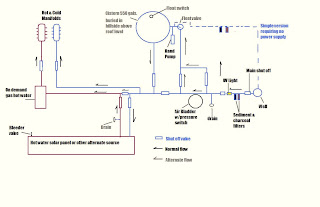 to provide water during power outages, however it will work for any home or cabin built on a hillside. I prefer locations like this due to the enormous weight of the cistern (which is above the roof level) when full. By burying the cistern you will also prevent freezing. In its simplest form it can provide water, both warm and cold to all interior fixtures with just a little muscle.
 to provide water during power outages, however it will work for any home or cabin built on a hillside. I prefer locations like this due to the enormous weight of the cistern (which is above the roof level) when full. By burying the cistern you will also prevent freezing. In its simplest form it can provide water, both warm and cold to all interior fixtures with just a little muscle.
Thursday, November 19, 2009
flat roof garden
This link, designed for city dwellers or anyone who has a flat roof, shows how easy it is to save money and go green at the same time. If you live in the city and have a flat roof on your building approach the owner or association to see if you can create a little paradise on your roof. I would imagine that this would be great for those who live in the southwest and have flat roofs as well. It would diffiently save you on air coniditioning while allowing you to have a great garden as well.
http://www.livescience.com/environment/091005-green-roofs.html
http://www.livescience.com/environment/091005-green-roofs.html
Thursday, November 12, 2009
Free air conditioning and heat

This is a very simplistic air conditioning/heat/fresh air system found everywhere on the internet. I found a patient date as early as 1903 on one version. The funny thing is it works as well today as it did then. This is the type of system that we will use in our underground housing project. If you can imagine, 63 degree temps coming from a simple pipe on a 95 degree day. Add to that >55 degrees coming from it on a otherwise freezing day in the winter. It wouldn't take no more than a wood stove or alternate heat source to make it very comfortable. In our underground house design it would take far less to make it a very comfortable 68 to 72 degrees, but who doesn't love a fire.
Tuesday, October 6, 2009
FREE SOLAR HOT WATER
 Free Solar Hot Water
Although this was built to heat a pool it can be used for other applications as well.
This is the result of an experiment to see if I could build a hot water solar panel absolutely free. AND IT WORKS!
I do tend to salvage more than the average person but if you look around your garage or shop you may find that you do as well. You can also modify to match what you have. I will post the drawings for the next proto type very soon that will cost around $100 or less to build using 1/2 copper tubing. The drawings are free and the more you can salvage or reuse the cheaper it will be. Let me know how you do.
I had salvaged the following:
(2) sets of old windows from a neighbor that was upgrading
(1) 50' 5/8"garden hose with a smashed end (not the best choice but it was free)
(1) gal. of roofing patch (left over from a repair job)
(2) male replacement hose ends
(1) old sheet of plywood
misc. PVC T's and valves
(2)steel reinforced washing machine hoses
several scrap 2x4's (various sizes)
several scrap 4x4's (various sizes)
The frame was built to accommodate three of the four window sections, if I added the fourth it would have been over 8' in length and more difficult to move around. As it is I can easily move to store or relocate. Once the frame is built drill two 5/8" holes in one side and laid out the hose so that the entire 50' fits into the box as flat as it can be to allow for maximum exposure. Cut the ends off of the hose and pushed them through the two drilled holes in the frame and attach the replacement male ends. Next stir the roof patch well and spread over the hose covering as much of the inside framework as possible. Insert the window frames and screw from the side. This will allow you to remove them for repair or to modify at anytime in the future (you will note a few walnuts in the photos from a neighbors tree and a crack in one piece of glass). Chalk the frames to water proof.
The stand is just 4x4's cut on angle and attached to a scrap piece of phywood with a 2x4 at the bottom to hold the panel in place. The panel is not attached to the stand. Think of an easel.
I will clean up this unit over the winter by staining the wood with a waterproof stain for a very aesthetic look and salvage something I can use to protect the glass.

Note the input and output hoses are washing machine hoses that are steel braided to help protect the exposed lines and they are designed for hot water.
 I used a 1" valve with a 3/4" tread adapter and tapped into the high side of pumps output line. The valve allows me to control the flow of water through the panel and also allows me to shut off the water when temps are acceptable. The return line tapped into the low side of the output. I wasn't sure at first if this would work well but it did. Next year I may replace it with a downward 45 degree tap that should allow less restriction on the flow.
This pump normally runs at 10PSI and there was absolutely no stress on the hoses.
When testing ( full sun) the panel rose to 175 degrees without the water flowing. When the pump was running, the panel temp. stayed around 135 degrees and the water flowed out between 100 & 110 degrees. Due to the size of the plumbing the cold mixes with the hot at an estimated ratio of 10:1. The pump only runs for 8 hours during the hottest part of the day (here 10am to 6pm) and with the help of a solar cover used at night the water temp stays between 86 & 90 degrees which is what I set out to do.
Although you can control the flow to the panel I normally leave it fully open as this is the range I was looking for.
Good luck if you decide to take on this endeavor. It was well worth the time.
Friday, October 2, 2009
A weekend getaway
Mountain View Solar and Wind, LLC is one of those companies serious about energy efficiency. Mike goes out of his way to educate people on the advances in the industry. Again there can be high cost involved so if you are able to attended his open house keep in mind that you are there to learn, not buy, unless you can afford to. Besides, you will probably need your money for shopping in Berkeley Springs. And make sure you talk to Mike vs. the vendors, he knows more about their products then they do.
And don't forget to take a few empty jugs to bring back the free & famous spring water.
Enjoy....
Thanks to KV for reminding me about the open house
2ND ANNUAL SOLAR OPEN HOUSE OCT 3RD & 4TH
We are hosting our second annual Solar Open House October 3rd from 10AM-4PM & the 4th from 12PM-4PM. We invite you to join us on a tour of a middle-class, average-sized home that is fitted with energy efficient equipment that can be used by mainstream America. The systems installed include grid-tied & net metered solar photovoltaic (PV), Velux solar hot water system, Skystream 3.7 wind generator, SIPs walls, high efficiency heat pump, radiant floor heat and all the electronics that make it operate maintenance free. Protect against power outages, high utility rates and reduce carbon emissions. Be part of the renewable energy revolution. There will be workshops on solar hot water, solar photovoltaics, small wind power, and geothermal heating & cooling. Solar House tours will be running throughout the day, and there will be a variety of professionals representing many green building technologies & products.
WHERE: 3026 Pious Ridge Rd, Berkeley Springs, WV 25411
WHEN: Oct 3rd from 10AM-4PM & Oct 4th from 12PM-4PM
COST: Free admission, food and drinks will be available to purchase. This year our open house is part of the American Solar Energy Society's National Solar Tour, for more info on the National Tour click here.
NOTE: We have had a great deal of interest in volunteering to help spread the word about the Open House & helping during the event. We are still actively seeking volunteers, and if you are interested please contact our Director of Operations, Colin Williams at (O) 304.258.4733 or via email at mvscolin@gmail.com
For a brighter energy future,
Kelly Waugh
Mountain View Solar and Wind, LLC
15 Greenway Drive
Berkeley Springs, WV 25411
(O) 304.258.4320
And don't forget to take a few empty jugs to bring back the free & famous spring water.
Enjoy....
Thanks to KV for reminding me about the open house
2ND ANNUAL SOLAR OPEN HOUSE OCT 3RD & 4TH
We are hosting our second annual Solar Open House October 3rd from 10AM-4PM & the 4th from 12PM-4PM. We invite you to join us on a tour of a middle-class, average-sized home that is fitted with energy efficient equipment that can be used by mainstream America. The systems installed include grid-tied & net metered solar photovoltaic (PV), Velux solar hot water system, Skystream 3.7 wind generator, SIPs walls, high efficiency heat pump, radiant floor heat and all the electronics that make it operate maintenance free. Protect against power outages, high utility rates and reduce carbon emissions. Be part of the renewable energy revolution. There will be workshops on solar hot water, solar photovoltaics, small wind power, and geothermal heating & cooling. Solar House tours will be running throughout the day, and there will be a variety of professionals representing many green building technologies & products.
WHERE: 3026 Pious Ridge Rd, Berkeley Springs, WV 25411
WHEN: Oct 3rd from 10AM-4PM & Oct 4th from 12PM-4PM
COST: Free admission, food and drinks will be available to purchase. This year our open house is part of the American Solar Energy Society's National Solar Tour, for more info on the National Tour click here.
NOTE: We have had a great deal of interest in volunteering to help spread the word about the Open House & helping during the event. We are still actively seeking volunteers, and if you are interested please contact our Director of Operations, Colin Williams at (O) 304.258.4733 or via email at mvscolin@gmail.com
For a brighter energy future,
Kelly Waugh
Mountain View Solar and Wind, LLC
15 Greenway Drive
Berkeley Springs, WV 25411
(O) 304.258.4320
Subscribe to:
Posts (Atom)
