This is the reality, if we don’t change now it will only get worst. Many of us were thought how to farm, make do with what we had or create what we needed. Are we teaching our children the same or are we sending them into the world believing that he who has the most toys wins.
Our farm lands are disappearing, our dependency on fuel oil has made us reliant on other countries, our place in the global market is dwindling along with the respect we once had because we no longer create, we only destroy.
In just Four Years, we can change everything…
Please click on the title to view video or copy and paste this link to your browser.
It is well worth your time..........
http://www.youtube.com/watch?v=B_6iTCo5Ci8
Showing posts with label solar. Show all posts
Showing posts with label solar. Show all posts
Thursday, March 25, 2010


Monday, March 15, 2010
Free Energy Is Here as it always has been.
What would you do if you had found the answer to all our energy needs? Would take the money they offer to keep it quiet or be stoned to death by the academics’ and corporations of the world for heresy against our energy dogma.
In my search for sustainable systems I have come across the principals of free energy many times. It is out there, though many will deny it, defending their PhD’s because they can’t bear to have been wrong all these years. I have enclosed links below because seeing is believing. Look these inventors up on you tube and you will be surprised at how many people have built these motors at home from junk based on the knowledge the men below have offered up for free. The principal is simple so don’t get lost in the technical details and circuitry or the arguments for and against. Just be aware that it is available to everyone. Several of the inventors have been told to keep quiet and refused, so they were debunked at every opportunity (Google; John Bedini or Tom Bearden). But magnetic motors have been around since 1269 AD.
Now, Steorn Orbo Technology (see; http://www.healthsalon.org/482/orbo-steorn-free-energy-electromagnetic-energy-is-here/ ) has put their own version out there for anyone to test and prove them wrong. If they can not find fault, and I don’t believe they can, everything we have known before will change. Imagine, cars, electricity for home and office, motors of all shapes and sizes that require no fuel. This is where we should be investing our money. And this is where we should have been years ago.
Remember the names Peter Peregrius (1269AD), Lee Bowmen (1954), John Bedini, Tom Bearden, David Hamel and now Steorn Orbo Technology. They have all built knowledge off of their predecessors and each other, they have stood in the forefront, taking their shots to the point of being called frauds but they will survive and you will benefit from their stubbornness.
To see for yourself visit the links below and the many others that will pop up.
http://www.healthsalon.org/482/orbo-steorn-free-energy-electromagnetic-energy-is-here/
http://www.icehouse.net/john1/bearden.html
http://www.youtube.com/watch?v=9JikYfmEdF8&feature=related
In my search for sustainable systems I have come across the principals of free energy many times. It is out there, though many will deny it, defending their PhD’s because they can’t bear to have been wrong all these years. I have enclosed links below because seeing is believing. Look these inventors up on you tube and you will be surprised at how many people have built these motors at home from junk based on the knowledge the men below have offered up for free. The principal is simple so don’t get lost in the technical details and circuitry or the arguments for and against. Just be aware that it is available to everyone. Several of the inventors have been told to keep quiet and refused, so they were debunked at every opportunity (Google; John Bedini or Tom Bearden). But magnetic motors have been around since 1269 AD.
Now, Steorn Orbo Technology (see; http://www.healthsalon.org/482/orbo-steorn-free-energy-electromagnetic-energy-is-here/ ) has put their own version out there for anyone to test and prove them wrong. If they can not find fault, and I don’t believe they can, everything we have known before will change. Imagine, cars, electricity for home and office, motors of all shapes and sizes that require no fuel. This is where we should be investing our money. And this is where we should have been years ago.
Remember the names Peter Peregrius (1269AD), Lee Bowmen (1954), John Bedini, Tom Bearden, David Hamel and now Steorn Orbo Technology. They have all built knowledge off of their predecessors and each other, they have stood in the forefront, taking their shots to the point of being called frauds but they will survive and you will benefit from their stubbornness.
To see for yourself visit the links below and the many others that will pop up.
http://www.healthsalon.org/482/orbo-steorn-free-energy-electromagnetic-energy-is-here/
http://www.icehouse.net/john1/bearden.html
http://www.youtube.com/watch?v=9JikYfmEdF8&feature=related
Monday, March 1, 2010
The 'sticker shock' of the new LEDs remains
I have worked as an electrician and a technical manager in electronics over the years and in my opinion, LED lighting will be the way to go. So much so, I am configuring it into most of my designs for sustainable living, but there is reason for that (keep reading).
The problem is how long it will take the manufacturers to get the retail price to a point where most people can afford to cash in on the savings. As it stands now, most people get sticker shock from the prices on LED's (approx $36.00 each)and revert back to incandescents or CFL's. If you can bite the bullet and switch over you will see the amount electricity you use for your lighting fall to 10% of what incandescents use. There is a drop of 43% of CFL's currently offer. In the long run, we are talking 25 years worth of lighting here, the difference between LED's and CFL's gets down to only a 1.1% difference in savings due to the high cost of the LED's.
As it stands right now, CFL's are the greatest value for you buck in the short term but keep watching for a reduction in LED pricing. Once it gets to under $20 per bulb start replacing them. If you are utilizing solar for electricity, which now. The LED's will free up well over half of the electricity you are getting from CFL's and 90% from incandescents resulting in smaller systems, less batteries and lower cost.
Click on the title link above and see a great cost comparison chart.
Definitions
The incandescent light bulb, incandescent lamp or incandescent light globe is a source of electric light that works by incandescence (a general term for heat-driven light emissions, which includes the simple case of black body radiation). An electric current passes through a thin filament, heating it so that it produces light. The enclosing glass bulb contains either a vacuum or an inert gas to prevent oxidation of the hot filament. Incandescent bulbs are also sometimes called electric lamps, a term also applied to the original arc lamps.
A compact fluorescent lamp (CFL), also known as a compact fluorescent light or energy saving light (or less commonly as a compact fluorescent tube [CFT]), is a type of fluorescent lamp. Many CFLs are designed to replace an incandescent lamp and can fit into most existing light fixtures formerly used for incandescents.
A light-emitting diode (LED) is a semiconductor light source. LEDs are used as indicator lamps in many devices, and are increasingly used for lighting. Introduced as a practical electronic component in 1962,[2] early LEDs emitted low-intensity red light, but modern versions are available across the visible, ultraviolet and infrared wavelengths, with very high brightness.
The problem is how long it will take the manufacturers to get the retail price to a point where most people can afford to cash in on the savings. As it stands now, most people get sticker shock from the prices on LED's (approx $36.00 each)and revert back to incandescents or CFL's. If you can bite the bullet and switch over you will see the amount electricity you use for your lighting fall to 10% of what incandescents use. There is a drop of 43% of CFL's currently offer. In the long run, we are talking 25 years worth of lighting here, the difference between LED's and CFL's gets down to only a 1.1% difference in savings due to the high cost of the LED's.
As it stands right now, CFL's are the greatest value for you buck in the short term but keep watching for a reduction in LED pricing. Once it gets to under $20 per bulb start replacing them. If you are utilizing solar for electricity, which now. The LED's will free up well over half of the electricity you are getting from CFL's and 90% from incandescents resulting in smaller systems, less batteries and lower cost.
Click on the title link above and see a great cost comparison chart.
Definitions
The incandescent light bulb, incandescent lamp or incandescent light globe is a source of electric light that works by incandescence (a general term for heat-driven light emissions, which includes the simple case of black body radiation). An electric current passes through a thin filament, heating it so that it produces light. The enclosing glass bulb contains either a vacuum or an inert gas to prevent oxidation of the hot filament. Incandescent bulbs are also sometimes called electric lamps, a term also applied to the original arc lamps.
A compact fluorescent lamp (CFL), also known as a compact fluorescent light or energy saving light (or less commonly as a compact fluorescent tube [CFT]), is a type of fluorescent lamp. Many CFLs are designed to replace an incandescent lamp and can fit into most existing light fixtures formerly used for incandescents.
A light-emitting diode (LED) is a semiconductor light source. LEDs are used as indicator lamps in many devices, and are increasingly used for lighting. Introduced as a practical electronic component in 1962,[2] early LEDs emitted low-intensity red light, but modern versions are available across the visible, ultraviolet and infrared wavelengths, with very high brightness.
Tuesday, December 8, 2009
Sneak peek at concept home

I have talked about this before so I thought I would give you a sneak peek of what my concept is for underground housing. Please excused the roughness, this was drawn with only a pencil and ruler on a rough dining table.
The floor plan for this model will be posted soon. The home is approx 1600 sq. ft., 3 bedroom /2 bath plus a 2 car garage.
- The 2 story atrium is 18' X 18' and is accessed from the master bedroom and dining area via french doors filling these area with natural sunlight. Additional natural light is brought in via solar tubes. The atrium also includes a spiral staircase to the roof (garden) which meets code for a second exit. The two additional bedrooms are located in the front of the home.
It will incorporate solar panels for hot water and electric, along with self-sustaining plumbing system, see previous blog. The louvers over the entrance area help shade the front during the summer but allow the lower winter sun to warm the front wall. Although minimal heat is required due the earth insulation.
The venting at the top allow for plumbing ventilation, radon gas evacuation along with air circulation venting (not shown) and the wood stove chimney. I may include as an option a wood oven and stove in case of long power outages.
I am working to get the total price of construction for this model down to <200k>
Thursday, December 3, 2009
This sucks!!!!!!!!!!! We have to do better!!!!!!
Today as I wandered through the internet researching the latest greatest advances in solar power I came across The American Solar Energy Society, their page to had a link to a solar calculator http://www.findsolar.com/index.php?page=rightforme.
Hey Great! I plugged in my average power usage for a 30 day period (from my electric bill) and let it do its thing. The calculator is based on professional installations using state of the art systems. The results are below.
This sucks!!!!!!!!!!! We have to do better!!!!!!
This is what drives me and this is why I am here to promote a grassroots effort to make it better and cheaper so that anyone can afford to reduce their carbon footprint and SAVE MONEY doing so. You can not rely on corporations when everybody is in this for major profit.
The results below show it will take 30 years to breakeven. Who but the wealthiest can or will do this? By the way, the newest of solar panels have a 30 year life expectancy and from what I have seen in the real world the power accessories (i.e. inverters, controllers and batteries) have far less. If you go this route you will never ever break even unless you back feed the grid and reduce you consumption. Even then they will only pay you the whole sale price (far less than what you are charged) for what you produce. I have seen advertised 'How-To' books (@$49.95) and videos on building your own solar panel for under $200, I have not purchased these guides simply because I know how to reuse old panels but I am very tempted to see if they are worth the money so that I can advise you on a better way.
For those of you interested in alternative methods, I recommend you visit another site I found. I have yet to read everything on it but it does look promising. Low Tech Magazine at http://www.lowtechmagazine.com/ for better solutions.
Calculator found at
http://www.findsolar.com/index.php?page=rightforme
System specifications for: Ranson, WV
Utility: Other
Solar Radiance: Solar radiance (insolation) is the amount
of solar energy received on a given
surface area in a given time. Commonly
expressed in kilowatt-hours per square
meter per day (kWh/sq m/day). This
measurement varies based on weather
and latitude of the given location. 4.62 kWh/sq m/day
Avg. Monthly Usage: This is the amount of electricity you
consume on average every month. It is
either determined by your input or
approximated by your electricity bill
divided by the cost per kilowatt hour
in your area ($0.0688/kWh). 1,526 kWh/month
System Size: This approximation is for a system to
produce enough electricity to offset
50% of your yearly usage.
It is determined by taking your avg.
daily usage, and dividing that by your
(solar radiance x 80%). The 80% is used
for the inherent inefficiencies in solar
power systems (95% inverter inefficiency,
89% weather impact, 95% inefficiency due
to soiling, utility, and module
inefficiencies). 6.85 kW
Roof Size: Approximate roof size needed to
accomodate your solar power system
can be deteremined by taking the
size of the system and dividing by
10 to get the square footage
(10 watts/sq ft). 684 sq ft
Estimated Cost: The approximate cost is an estimation
based on a price of $8/watt. This is
the average rate, including parts and
installation, for systems above 2kW. $54,782.04
Post Incentive Cost: The post incentive cost is an estimation
based on the available credits/rebates for
your area. This may include kWh
production incentives for up to 25 years
if applicable in your area. This provides
an approximation of the local/state
incentives, and should only be used as
an approximation. $36,947.43
Federal Incentives
Tax Credit: 30% Federal Renewable Energy Tax Credit
State Incentives
Tax Credit: 30% ($2,000.00 max) Residential Solar Energy Tax Credit
Estimated Cost: The approximate cost is an estimation based on a price of $8/watt. This is the average rate, including parts and installation, for systems above 2kW. $54,782.04
Post Incentive Cost: The post incentive cost is an estimation based on the available credits/rebates for your area. This may include kWh production incentives for up to 25 years if applicable in your area. This provides an approximation of the local/state
incentives, and should only be used as an approximation. $36,947.43
Avg. Monthly Savings: $52.49 25
Year Savings: The 25 year savings is based on the
amount of electricity cost you save over a 25 year period assuming a yearly
4% increase in utility rates. $26,234.12 25
Year ROI: 71.00%
Break Even: 30.79 years
The electricity you use causes the release of 27,468 pounds per year of carbon dioxide (which promotes global warming). Driving 30,438 miles in an average car emits an equal amount. To offset the yearly emissions, it would require planting 69 trees a year.
Hey Great! I plugged in my average power usage for a 30 day period (from my electric bill) and let it do its thing. The calculator is based on professional installations using state of the art systems. The results are below.
This sucks!!!!!!!!!!! We have to do better!!!!!!
This is what drives me and this is why I am here to promote a grassroots effort to make it better and cheaper so that anyone can afford to reduce their carbon footprint and SAVE MONEY doing so. You can not rely on corporations when everybody is in this for major profit.
The results below show it will take 30 years to breakeven. Who but the wealthiest can or will do this? By the way, the newest of solar panels have a 30 year life expectancy and from what I have seen in the real world the power accessories (i.e. inverters, controllers and batteries) have far less. If you go this route you will never ever break even unless you back feed the grid and reduce you consumption. Even then they will only pay you the whole sale price (far less than what you are charged) for what you produce. I have seen advertised 'How-To' books (@$49.95) and videos on building your own solar panel for under $200, I have not purchased these guides simply because I know how to reuse old panels but I am very tempted to see if they are worth the money so that I can advise you on a better way.
For those of you interested in alternative methods, I recommend you visit another site I found. I have yet to read everything on it but it does look promising. Low Tech Magazine at http://www.lowtechmagazine.com/ for better solutions.
Calculator found at
http://www.findsolar.com/index.php?page=rightforme
System specifications for: Ranson, WV
Utility: Other
Solar Radiance: Solar radiance (insolation) is the amount
of solar energy received on a given
surface area in a given time. Commonly
expressed in kilowatt-hours per square
meter per day (kWh/sq m/day). This
measurement varies based on weather
and latitude of the given location. 4.62 kWh/sq m/day
Avg. Monthly Usage: This is the amount of electricity you
consume on average every month. It is
either determined by your input or
approximated by your electricity bill
divided by the cost per kilowatt hour
in your area ($0.0688/kWh). 1,526 kWh/month
System Size: This approximation is for a system to
produce enough electricity to offset
50% of your yearly usage.
It is determined by taking your avg.
daily usage, and dividing that by your
(solar radiance x 80%). The 80% is used
for the inherent inefficiencies in solar
power systems (95% inverter inefficiency,
89% weather impact, 95% inefficiency due
to soiling, utility, and module
inefficiencies). 6.85 kW
Roof Size: Approximate roof size needed to
accomodate your solar power system
can be deteremined by taking the
size of the system and dividing by
10 to get the square footage
(10 watts/sq ft). 684 sq ft
Estimated Cost: The approximate cost is an estimation
based on a price of $8/watt. This is
the average rate, including parts and
installation, for systems above 2kW. $54,782.04
Post Incentive Cost: The post incentive cost is an estimation
based on the available credits/rebates for
your area. This may include kWh
production incentives for up to 25 years
if applicable in your area. This provides
an approximation of the local/state
incentives, and should only be used as
an approximation. $36,947.43
Federal Incentives
Tax Credit: 30% Federal Renewable Energy Tax Credit
State Incentives
Tax Credit: 30% ($2,000.00 max) Residential Solar Energy Tax Credit
Estimated Cost: The approximate cost is an estimation based on a price of $8/watt. This is the average rate, including parts and installation, for systems above 2kW. $54,782.04
Post Incentive Cost: The post incentive cost is an estimation based on the available credits/rebates for your area. This may include kWh production incentives for up to 25 years if applicable in your area. This provides an approximation of the local/state
incentives, and should only be used as an approximation. $36,947.43
Avg. Monthly Savings: $52.49 25
Year Savings: The 25 year savings is based on the
amount of electricity cost you save over a 25 year period assuming a yearly
4% increase in utility rates. $26,234.12 25
Year ROI: 71.00%
Break Even: 30.79 years
The electricity you use causes the release of 27,468 pounds per year of carbon dioxide (which promotes global warming). Driving 30,438 miles in an average car emits an equal amount. To offset the yearly emissions, it would require planting 69 trees a year.
Tuesday, November 24, 2009
Self sustaining plumbing system
I designed this plumbing system for an underground home in a remote area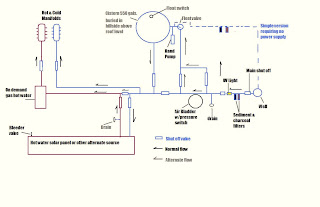 to provide water during power outages, however it will work for any home or cabin built on a hillside. I prefer locations like this due to the enormous weight of the cistern (which is above the roof level) when full. By burying the cistern you will also prevent freezing. In its simplest form it can provide water, both warm and cold to all interior fixtures with just a little muscle.
 to provide water during power outages, however it will work for any home or cabin built on a hillside. I prefer locations like this due to the enormous weight of the cistern (which is above the roof level) when full. By burying the cistern you will also prevent freezing. In its simplest form it can provide water, both warm and cold to all interior fixtures with just a little muscle.
Thursday, November 12, 2009
Free air conditioning and heat

This is a very simplistic air conditioning/heat/fresh air system found everywhere on the internet. I found a patient date as early as 1903 on one version. The funny thing is it works as well today as it did then. This is the type of system that we will use in our underground housing project. If you can imagine, 63 degree temps coming from a simple pipe on a 95 degree day. Add to that >55 degrees coming from it on a otherwise freezing day in the winter. It wouldn't take no more than a wood stove or alternate heat source to make it very comfortable. In our underground house design it would take far less to make it a very comfortable 68 to 72 degrees, but who doesn't love a fire.
Subscribe to:
Posts (Atom)
